
Lauren here—It’s Tuesday, and I still haven’t changed out of my leggings from yesterday. My girls just announced that they will not be entertained by an app for the next hour. They want activities, and we know they mean right this second, using only stuff from the house! So here are 28 ideas you can use starting today with household items.
Don't lose this article. Enter your email below, and I'll send it to you right now. Plus a little encouragement and inspiration from me, straight to your inbox.
I will be writing these from my kitchen floor during marker battles and coffee refills so you can expect real steps and tips that work with kids. You will find games, simple experiments, and activities that are quiet and require no extra supplies, just some time and things you have in the kitchen.
1) Indoor scavenger hunt with picture clues
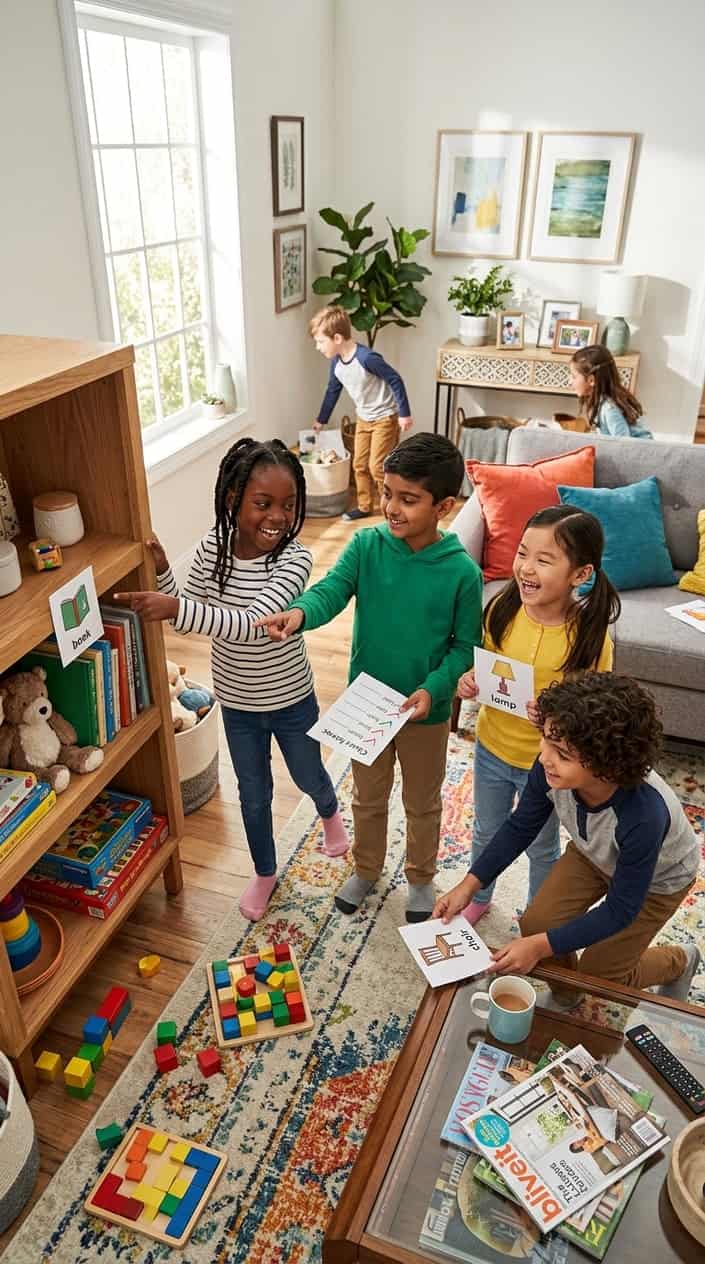
I admit that while they do the treasure hunt, I sit on the couch and drink my tea. I take quick pictures of the spots in the treasure hunt, like the blue couch cushions, the red mug on the counter, and the plant by the window.
The only materials you will need are a phone or camera, paper, tape, and some small prizes/treats (stickers work too). Take pictures of the clues (or draw them) and then tape them around the house. You’ll give the kids the first picture so they know where to go. The rest of the clues are hidden. This is a good strategy to make it easier for younger kids to win!
Utilize a sequence such as easy to more difficult. Use small prizes as incentives. If one child reads better, have the other child find the matching colors so they can all get hyped up.
2) Sock puppet theater and improv show

Once, my kids wouldn’t share a toy car so I made puppets out of socks. I figured if I could turn laundry into a cast, we could get a few minutes of peace.
Grab some mismatched socks, markers, buttons, yarn, a cardboard box (or a spoon) to make a stage. Use a sock to cover your hand to create a puppet. Draw a face and then glue or tie some yarn for hair. Next, use a box that is turned on its side to create a theater. Give each puppet a goal, such as finding a snack or fixing a toy. After that, let your kids improvise lines.
Keep the scenes brief, and if they stall, give simple prompts. Use different voices and quick props (a hat can be a spoon!) to reset the energy. Rotate performers so that everyone has a chance to go behind the scenes.
3) DIY obstacle course using pillows and tape

I admit that I made a ”lava path\” once and it worked more than I expected. It’s easy and makes a lot of noise. It tires them out quicker than an entire marathon of cartoons.
Get some pillows and sheets to use as obstacles. You will also need masking tape and some safe chairs. Use the tape to mark start and finish lines and to set up paths. For stepping stones, use the pillows. Drape a sheet over a couple of chairs to make a tunnel. Use a broom as a limbo stick.
Have clear rules like no jumping off high furniture or only one kid per obstacle. Set time limits and make mini challenges like hopping on one foot. You can also change parts if someone’s hogging an obstacle. I like to keep a small prize like extra story time because it stops the whining.
4) Kitchen science: vinegar and baking soda rockets

I used to be really anxious about experiments that may get a bit messy, but with the right plan, this one can be quick and really clean. The girls appreciate the surprise launch and I appreciate that cleaning up involves just a paper towel.
All you need is a small plastic bottle, some baking soda, vinegar, a paper towel and a cork or stopper that fits tightly. Put a spoonful of vinegar into the bottle and make a small paper towel packet with a teaspoon of baking soda inside. Drop the packet in, quickly put the cork in, and set the bottle upside down in a yard or on a tray. Step away.
To keep it safe, have them use a smaller paper towel packet so the reaction is delayed long enough for the kids to back away. Do this outside, or over something that is easy to clean, keeping your face and anything breakable away.
5) Homemade play dough with flour-salt-oil recipe

I make this play dough when time is short, and the store-bought tubs have run out. My daughters can play for hours. I also feel super smart for using ingredients from the pantry!
You will need some flour, salt, oil, water, and cream of tartar if you have some. Mix 2 cups flour, 1 cup salt, 2 tablespoons oil, and 2 tablespoons of cream of tartar and then add about 1 to 1¼ cups of boiling water. Once it forms, knead it when it cools and add food coloring while you knead.
Using a cookie sheet or placemat while cleaning up will make it easiest! Also, keeping snacks separated in batches works best! *Tip- Keep one batch unsalted! Then they can trade and mix!* Vanilla or cinnamon can be added to the other batch for an added treat. The snack can be kept in a bag and stay fresh for up to a few weeks.
6) Story stones made from smooth pebbles and markers

I keep a jar of smooth pebbles because my girls take anything half-round for pretend tea parties. I admit I enjoy how quiet the story stones are—no glitter avalanche, just markers and imagination.
To start, grab a few small stones (or purchase an inexpensive bag of them) and get a few other materials: a washable tray or towel to protect the table, a permanent marker, and some pebbles (or buy a cheap bag of stones). Then, draw a few simple stick figures, a house, a sun, a car, and some movement symbols (i.e., an open door, a boat).
Place the stones in a bowl. Each child will take turns selecting three stones to make a short story. You can use some acting prompts, do some sound effects, change stones in the middle of the story, or arrange them in a line to create a sequence.
Tip: For younger kids to recognize your drawings, try to keep them simple and bold. To make the set more special, kids can add their own characters later.
7) Living room camping with blanket fort and flashlight stories

I confess that at times I build a fort in my home, so that I can go in there with a coffee and indulge in a little camping fantasy. It gives me ten minutes of peace and quiet and the children think we are on a great expedition.
If you want to build a fort, the supplies you need are, blankets, clips, couch cushions, and a flashlight. First, put a blanket over the couch and use clips to keep the edges up. Then, place some pillows on the floor to make a “sleeping bag” area. Lastly, turn the lights off and give each child a flashlight.
You can tell stories while shining the flashlight, and you can let each kid have a turn. You can also pack some snacks in small bowls so people can stay cozy in the fort and no one has to leave to get food.
8) Family yoga session with kid-friendly poses

I started doing yoga so I could stretch after both running and parenting. Now, the kids often request to do yoga when it is time to calm down. It beats the negotiation around screen time and gets everyone moving without making a mess.
To get started on this activity, clear a space on the floor and grab some towels or bath mats to use as mats. Set a timer for 10-15 minutes. Pick three simple yoga poses like downward dog, tree pose, and child’s pose, and show one pose at a time.
Take your time when showing the poses and use fun names like “sleeping butterfly” and “mountain” to make it more engaging. You could even offer to do “tree pose” and ask if they want to do arms like branches or arms like a superhero. Remember to praise children for their efforts rather than perfection. If someone is swaying, do a confident countdown, and it will work.
9) Paper airplane contest with distance rules

I started planning when the house was quiet enough so I could fold planes without stepping on one. This is cheap and quick to do, plus my daughters have turned the hallway into a runway, so it was great for rainy day activities too.
Materials you need: printer paper (or old homework sheets), tape, measuring tape (or step counter), and a marker to mark the lines. Use the tape to create a start line and mark zones every two feet. Each player gets three throws, measure the farthest throw, and if a plane is trick folded, add five inches for any trick folds.
To make sure younger kids don’t get upset or discouraged, try to demonstrate one basic fold and one stunt fold. Take a score on a sticky and tell them they will get a small prize. A free minute of screen time works great.
10) Shadow puppet stories using a lamp

I usually end up on the floor with this one because it’s easier to referee sock stealing before we start. My girls like making animals with their hands and I like that it takes 5 minutes or less to set up.
You just need a lamp with a shade, a blank wall, two flashlights or a phone light. Turn off the room lights, shine the lamp onto the wall, and sit between the wall and the lamp so that your hands make huge shadows. Show the shapes of a bird, dog, and bunny and then let them create their own.
Shadows are fuzzy? Move the lamp to the wall or use a brighter bulb. If your attention drifts, use paper cutouts taped to a ruler to quickly create repeating shapes and story prompts.
11) Alphabet hopscotch with painter’s tape

I set this up while on my break. I even managed to get 20 minutes of time to myself. My girls got a kick out of calling out the letters while I enjoyed my coffee like it was some fancy trophy.
Find some open space in your home, such as a hallway or a bedroom. Use painter’s tape and a marker to create a grid on the floor that has squares and rectangles. Write one letter in each square and leave spaces in between the letters so you can hop. If you do not have tape, masking tape, or cut paper squares can be used instead.
You can call out letters and have children jump to them or jump through letters to spell words. To make it even more exciting, you could add a time limit and a rule that every time a vowel is called, they need to clap. Just a reminder, if you ask kids to take off their shoes for grip, tape the edges down to keep the tape from sticking.
12) Baking muffins together with measuring practice

I bribe my daughters with warm muffin batter to do math. They even do the fractions when I promise them a warm muffin and do a little kitchen dance while they wait.
The ingredients that we will use are: flour, sugar, baking powder, eggs, milk, and oil. The other materials we will need are a bowl, measuring cups, and a muffin tin. Each kid can measure one ingredient while you supervise. Show them to level the cup with a knife and count the spoonfuls out loud.
Steps are easy for kids to follow. One will mix the \\”wet\\” ingredients, and one will mix the \\”dry\\” ingredients, and then they will combine them. To make clean up easier, use paper liners, and for the kids to learn about minutes, set a timer. There are lessons to learn, such as spilled flour. Make praise for their efforts and not the end results.
13) Nature collage from yard finds and glue

I try to send the kids outside for at least five minutes of peace and quiet. When the kids come back, they argue about what they call a \\”treasure pile\\”. It’s all cheap junk, and the mess stays mostly outside, at least, until glue is involved.
Plan your creation with a child’s design in mind. Collect materials such as leaves, petals, small rocks, twigs, glue (white glue, glue sticks), and some cardboard or pieces from cereal boxes. Make your design by gluing the pieces to the cardboard.
Tip: Place some leaves that are flat under a heavy book for a few minutes so they stick better. Use small dots of glue for tiny bits, and larger blobs for heavier pieces.
14) Balloon volleyball using a broom handle net

I’ll admit I once made a championship with a broom and a sheet I tied to it. It kept two kids on a sugar high for 30 minutes, and only one vase almost died.
You need two chairs, a broom or mop handle, and a balloon (which can be tape or string). With the chairs propped back-to-back, place the broom across them like a net, and tape it so it doesn’t roll. Inflate the balloon and set some basic rules of the game: only three touches, no running into furniture.
Tip: A balloon that is too light will float slowly. If kids are spiking too hard, lower the net. If that doesn’t help, try switching to a softer balloon. Keep turns short and cheer loudly — they will play longer than expected.
15) Minute-to-win-it silly challenges (stack cups, cookie face)

I want to see fast results. When my patience runs out, I grab the minute games with the noisy energy. The whining stops quickly. Plus, the house is usually left intact.
Here’s what you need: plastic cups, a cookie or cracker, a spoon, a timer or a phone. For the cup stack, set out 15 cups face down in a pyramid and time who can stack and unstack the fastest. For cookie face, place a cookie on your forehead and try to get it in your mouth without using your hands.
To start, draw a start line and set a one-minute timer. Explain the rules once, and do a practice round so they can stop arguing about fairness. To keep it friendly, or competitive, offer small prizes like choosing what we have for dinner, or picking the next song.
16) Make-your-own comic strip with sticky notes

My husband has a ton of sticky notes, and I guess I borrow them for reasonable cause — they stick, they peel, and the kids love moving the pieces around! It’s less expensive than store-bought kits and lasts much longer.
Don't lose this article. Enter your email below, and I'll send it to you right now. Plus a little encouragement and inspiration from me, straight to your inbox.
All you need is sticky notes, a pen, and a flat surface like a table or poster board. Give each kid about 3 to 5 notes so that they can create a short strip: setup, middle, and punchline. For each child, draw a panel with only one line so that it’s simpler, and remind them to keep the dialogue inside the speech bubbles.
Set a timer for 5 minutes to keep the kids on task. If they stall, offer them the chance to trade sticky notes to remix the story. You can take completed strips and tape them to the fridge for some instant applause.
17) Watercolor resist art using crayons and diluted paint

I will say this: I will always pick washable crayons over a splurge at the craft store because it saves both my sanity and my wallet. My girls are crazy about the mystery of the white crayon and what surprise will be revealed once paint is applied.
The required materials for this activity are some plain sheets of paper, crayons (either white or colored), watercolors (you can use food coloring diluted in water), a container of water, and a paint brush. To start, instruct the children to use a crayon to make a drawing. They should push down hard enough to create a good resist. After that, you’ll want to mix the paint with water so that it becomes thin and translucent.
To stop the paper from bending, stick it to the table with tape. After that, paint the whole sheet and the crayon lines will stay bright. If there are blobs of paint, just dab them with a paper towel. Allow the pieces to dry flat.
18) Memory tray game with household items

One time I left a random pile of stuff on the counter to try to entertain my girls and it ended up starting a full-on memory battle. It’s cheap, instant, and usually keeps them quiet for five minutes—gold.
Gather 10-15 small household items, for example, a spoon, sock, key, button, toy, pencil, and coin. Spread the items over a tray or placemat and let the kids look at the items for 30-60 seconds. After that, cover the items with a towel. Ask them to write or tell you what they can remember.
To begin, less is more. You can give hints by saying “kitchen” or “school” or one of the other categories. Have each person take turns hiding objects. For some extra fun, you can even add a timer for bragging rights!
19) Dance party with themed playlists and freeze-dance

I admit that I sometimes use music to get through the witching hour, and a themed playlist creates a little vibe. 80s pop, movies, or just jungle drums are guaranteed to get my kids hyped.
Here’s what you need: a phone, a speaker or laptop, and some space. You will make three playlists: one for warm-ups, one for a go-wild, and one to calm down. For props, use household items such as a scarf, hats, and flashlights for spotlighting.
Rules are easy: One parent acts as DJ, and it’s one round of freeze dance after three songs. When the music stops, everyone has to freeze. The first person to move has to do a silly task, like go get a snack. Try to keep your rounds short and switch themes every 10 minutes to keep the energy up!
20) Indoor garden starter in egg carton seed pots

I’ve got twelve empty egg cartons, and a kid who wants to “plant something.” It’s cheap, easy, and keeps them occupied for more than five minutes.
What you need: an empty egg carton, some old potting soil or garden dirt, seeds (beans, herbs, or lettuce), a spoon, and a spray bottle or small cup. (Optional) After you cut the carton lid off, fill each cup with soil, press a seed in about a thumb’s depth, and mist lightly. Put the carton on a sunny windowsill and keep watering until the top is dry.
Use a pencil or some scrap paper to label each cup so that the kids can see which seeds grow. If the roots poke through the bottom, transplant into a larger pot or directly into the garden.
21) Sensory bin with rice, spoons, and small toys

One time, I spilled an entire bag of rice on the floor and called it an art installation. Even though cleaning it up will take time and is definitely annoying, I think playing with it is worth an hour of fun.
To make this activity, you need a plastic bin, some dry rice, measuring cups, a few tablespoons, and small toys like mini cars, animal figures, beads, buttons, etc. Put the rice in the bin, hide the toys in the rice, and give each child a spoon and a cup.
To make cleaning up the mess easier, you might want to put the bin on a towel. Instead of rice, you can use pasta, beans, or oats. Please watch the toddlers while doing this activity. If there are children who tend to put things in their mouths, avoid using small items.
22) Create a family time capsule and bury in backyard
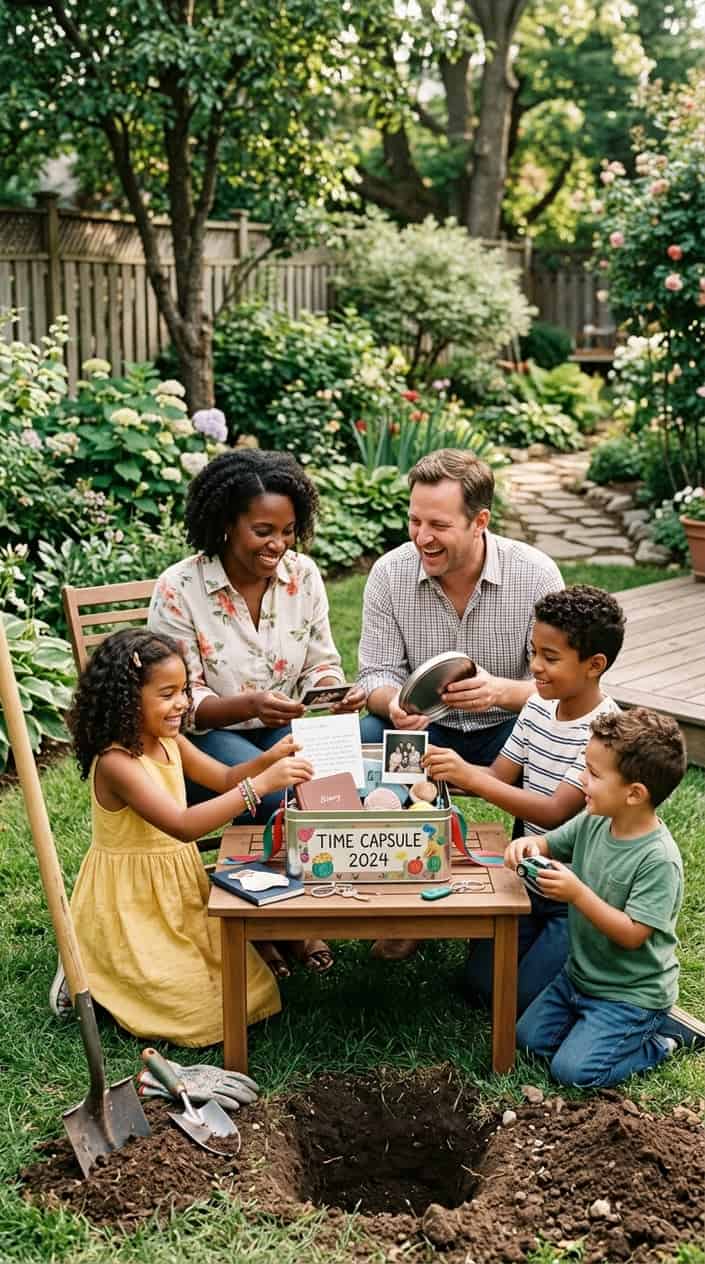
I’ll own it. One time, I taped my middle child’s note to a stuffed dinosaur and called it history. It still works — kids still enjoy secrets that are hidden.
Grab some paper, crayons, a photo, and tape. Then, write some notes about the day and slip a photo in. You’ll also need a sturdy container such as a cookie tin or plastic food tub, some small toys, and a durable container. Find a short area in the yard that has stones or some sort of plants to mark it off. Dig a small hole that won’t get filled with water.
Five or ten years seems like a good time to set a date to reopen it. Each child should be able to personalize their label. Explain the rules: no one may look, and everyone assists in the burying, because it becomes a family memory.
23) Homemade musical instruments from tins and rubber bands

I admit that at one time I had to make an entire band out of cookie tins because I needed a minute and my girls wouldn’t nap. It worked! The noise and chaos turned into 30 minutes of them playing together while I got to enjoy my cold coffee.
You can make your own instruments using empty containers such as tins and yogurt cups, as well as rubber bands and pencils. To make a guitar, pluck or strum the rubber bands that you stretched around a tin or a cup. Use a pencil as a drumstick to strike some tins that are upside down, and for a shaker, an adult can tape or glue a paper plate to a cup, and then fill the cup with rice or beans.
To make it fun, keep it simple. Go over everything quickly, label the parts with a marker, and show them one trick. Encourages experimentation. Stow it in the box so you can pull the “band” out for a repeat performance whenever you need to.
24) Puppet sock matching and storytelling game

I have a good amount of single socks. I can’t get rid of them because that almost seems like losing the battle. I also make puppets from the socks, and I play a real quick matching game to give myself ten minutes of calm.
Gather some unmatched socks, rubber bands, buttons, and markers. Have pairs of socks set face down, and let the kids pick two. They’ll make puppets, and then have one minute to tell a story about the characters. Use story prompts like “who’s at the door?” to keep the story going.
Toddlers only need to do a quick color or pattern matching activity; they don’t need to do the whole story. For older kids, do a story twist! Encourage them to swap puppets during the story or have each puppet say a special secret word! Keep your activities quick and within reach to hold their attention.
25) Simple sewing: felt shapes and a plastic needle

I admit that I started this to distract the girls from screens and ended up getting a mug of cold coffee while they were stitching. It is low mess, quiet, and gives them a small win when a heart or star stays together.
Here’s what you need: Old fleece or felt scraps, soft plastic needles for sewing, blunt embroidery yarn, markers to write down your sewing shapes, scissors, and of course the simple shapes to cut out, or let the kids draw and use cookie cutters to trace some shapes. Stack two pieces, and poke the needle through. Then, use running stitch or whip stitch to finish. Remember to knot the start and finish.
Younger participants can be ready by creating bigger holes so that they are able to just thread and pull. Praise wobbly stitches. They show effort and should not be seen as failures.
26) Cardboard box car races with marker decorations

I’ll admit that I let some Amazon boxes become an all-day race track, because if I didn’t, my girls would just keep arguing. It gives some peace and lets them be active without a trip to the store.
Here’s what you will need: big cardboard boxes, washable markers, scissors, tape, and optional paper plates. First, cut holes in the boxes for heads and arms, then let the children draw things like headlights, flames, or license plates. Tape the paper plates, which will act as wheels, to the sides of the boxes. Finally, use painter’s tape to mark a start and finish line in the hallway or outside in the yard.
Tip: Instead of calling a race, explain to each child that they have a simple rule to follow. In this case, it will be \”no running with boxes.\” Then, do a timer, count to ten, or do a quick leap to ten for a short distance. I always keep some wipes and an extra change of clothes handy.
27) Cooking lesson: make homemade pizza together

To be honest, I bribe my girls with pizza. They love to help in the kitchen! They measure, stir, fight over toppings, and I finally get a moment to fold the laundry.
You will need flour, salt, water, yeast (or quick-rise baking powder), olive oil, cheese, toppings from the fridge, and tomato sauce. Mix the dough in a bowl and let it rest for 10-20 minutes. After, press it into pans or bake it on a sheet. Kids can spread the sauce and sprinkle it on the cheese. To avoid fights, give each child a separate section.
Organize the dough, sauce, cheese, and toppings into bowls for each station. Use a rolling pin or a clean water bottle to help spread the dough. Keep oven tasks for adults and timer setters. Encourage messy hands — it helps them keep trying new things.
28) I-spy window game for car or porch watching

I’ll admit that occasionally I do park by the window. I put a mug in the front with the kids, thinking I’m on some sort of stakeout, so they can see I’m not going insane, and it does work. Everyone plays without me having to do anything, and I get a little break.
Materials: Window, sticky notes, and a pen. Grab a seat by the window or a bench, then take turns spotting items. Examples: blue car, dog w/red leash, delivery van. Write the items down, or keep score to make it competitive.
To keep the kids focused and engaged, set a timer for 5 to 10 minutes. Add rules such as no repeating item names, or make sure streets and colors are named to get a point. To make sure everyone gets a turn as the spy and calls out the items, rotate roles.
Keeping Screen Time in Check: Real-Life Wins and Woes
While preparing lunch, I go through the same threads on the parenting screen time rule debates. I want specific and undeniable guidelines, but I also want my children to be silent long enough that I can chop some veggies without having to referee a dispute about the coloring markers.
Balancing Devices and Sanity
I have a simple system where I’m not the enemy. On weekdays, we start our screen time 30 minutes after homework is done. On weekends, we start screen time 90 minutes after homework is done. I set a kitchen timer so I don’t have to be the enemy, while the kids see it’s not my mood, it’s the number on the timer.
What do you need? a dry-erase marker, a small timer or phone alarm, and three reward chips (paper circles are fine). You set the board with a time bank, and they can buy minutes. Tips: trading screen time for chores should only be done once a week, or they will know how to fold a sock and will demand you to give them two hours of screen time.
Why Boredom Isn’t the Enemy (Even If It Drives Me Nuts)
“I’m bored” used to send me into panic mode. Boredom = chaos, and it would go crazy fast. Now, I pretend I forgot I have a boredom box (library books, a deck of cards, a puzzle), and simple challenge cards (just build a fort using three pillows). It seems to slow the meltdown without me having to micromanage.
Here’s what you need to get started: a shoebox, small toys, crayons, index cards. Activities: Write ten activities, fold them, and put them in the box. Tips: Let them pick a card twice a week. Otherwise, they will learn to milk a single activity for way too long.
Making Space for Imagination (and the Mess That Follows)
I shouldn’t consider glitter the enemy, but a huge messy project can silence my girls for an hour! That’s a win. I can formulate some rules and have a tiny cleanup plan to keep our house livable while the kids create and explore.
Setting Boundaries Without Crushing Creativity
I have created a rule that states that messy things have to go on a taped-off blanket. For this, I use a cheap tablecloth or an old shower curtain, then I tape the edges with painters tape to mark the play zone. Explain the rule once: No food in the kitchen, no paint off the drop cloth, and toys have to be put back in the labeled bins when time is up.
For each child, prepare a tray with the essential supplies (i.e., cups, glue, scissors, markers) to help minimize the chances of them wandering off. To help get everyone cleaned up, set a 10 minute timer. Children are more motivated to assist with cleaning when they can see a clear end. To incentivize clean up, offer an immediate, small reward like a story, five minutes with a preferred toy, or a sticker.
Embracing the Big Mess—And the Little Victories
I get that some days need the carpet to be vacuumed three times. I do a sort of triage when a project goes out of control: remove anything wet, scoop up any solids into a bin, and wipe surfaces with a cloth that’s damp. Under the sink, keep a little “mess kit” that includes baby wipes, paper towels, a dustpan, and spray cleaner for quick and not-dramatic cleanup.
We celebrate the little wins! I praise kids when a tool gets returned, a drop cloth gets folded, or the pan gets swept. These are small wins but they show kids how to be individually responsible and keep the fun intact. Over time, kids make more and more contributions and, as a result, the mess they create goes down.


