

Since it’s pouring outside, and the little ones are getting restless, why not set up some obstacle courses? Grab some cushions, a rug, and a laundry basket, and let me help you turn that untamed energy into 19 different activities, such as cushion obstacle courses, sock-sliding sprints, and pillow balance walks. This will help them focus their energy and calm their minds!
Don't lose this article. Enter your email below, and I'll send it to you right now. Plus a little encouragement and inspiration from me, straight to your inbox.
The activities I’ll be sharing are the result of testing the ideas with my girls (and yes, I’ve sacrificed a few of my throw pillows). You’ll find simple ideas, what skills the activities help develop, and suggestions to modify them for toddlers all the way to school-aged kids, so you can maintain your sanity and keep the peace.
1) Couch Cushion Obstacle Course

The children leap from \\”cushion island\\” to \\”carpet river,\\”, crawl through the blanket tunnel, and shimmy along the armrest as if it were a balance beam.
Expect a lot of noise, giggles, and comments like “I almost fell”. They will do jumping, balancing, and core strengthening activities.
Usually, speed cleaning only takes about two minutes. For younger children, you should keep the distance between the hurdles smaller and stay closer. For older children, you can introduce a timer and a toss-and-land station for added difficulty.
2) Sock-Sliding Sprint (hardwood or laminate)

I take off my shoes, put on my socks, and place my cushions to mark my starting spot. We set up for a run across the living room! The kids slip, the dog races, and I try not to laugh!
Sure, it resembles an unorganized drawing gone wrong, but this is actually very functional! This activity is using all sorts of gross motor skills! To perform all these actions, it requires the use of body parts! The children need to use their legs, core, and balance to quickly stop and use their coordination.
What you need is a smooth space to play, an open area, and some cushions for goals. If you’re playing with younger kids, grab their hands and help them jump the distance. For older kids, you can do fun things like “stop-and-spin” or slow-motion rounds.
3) Pillow Tower Balance Walk

I encourage my kids to walk over a column of our sofa cushions and pillows that I’ve set up on the floor like a wobbly bridge. Then I prepare to start the timer and bribe them with a snack. They try to get across without ‘falling’ into the couch, which I like to call a ‘dog pile’.
Even though this activity may not feel like gym class, it is still beneficial for the children’s core, balance, coordination, and concentration. They focus on steadying their feet while trying not to collapse the tower, and even laugh while doing so.
This takes 30 seconds! Stack the tower high and the pillows low, so falls are safe. Bigger kids can add a pillow \”checkpoint\” to pause at, while toddlers can do this with their hand.
4) Laundry Basket Scooter Races

Imagine kids in laundry baskets using their feet to push off the couch and squeal as they fly down a clear patch of carpet. I referee, give out toy helmets, and do my best not to laugh when Grandma participates. It’s quick, it’s goofy, and our living room turns into a miniature race track.
Using their large muscles and gross motor skills, they steer with their core, shift their weight to turn, and use balance and coordination.
You need two strong laundry baskets and some socks or dishcloths that will serve as “scooters.” Make sure to establish a lane that is clear and smooth. For the younger kids, stay in the lead at a slower speed; for older ones, use cones or shoes to designate turns. I always set up a soft finish line to prevent kids from slamming into the hard furniture.
5) Balloon Volleyball Rally

I clear the coffee table and tape a “net” made of yarn between two chairs, then we whack a balloon back and forth. That is, until someone giggles too much and misses. It’s super chaotic, kids are jumping around, and I’m pretending not to duck, but at least it gets everyone moving and laughing.
This also helps with gross motor skills such as arm swinging, short sprints, hand-eye coordination, and even balance when they lunge for a balloon. Since this activity is low-impact, tired kids can also take part.
See if you can grab some chairs, balloons, and yarn. For toddlers, keep the rallies closer and calmer. For older kids, throw on rules like max two hits. You can also do a round where no one is allowed to use their hands.
6) Tape-Marked Balance Beam on Floor

I put a piece of painter’s tape on my living room rug, and now the kids have a tightrope to walk on. They are doing heel-toe walking, jumping, and pretending the couch is lava, all while I sip my coffee and count.
They are using your balance, core, and coordination. Gross motor play is the use of large movements, the whole body, to keep them standing and steady.
Grab some painter’s tape (it won’t ruin the floor) and create a line or zig-zag. For big kids, you can add some challenges like a time limit or walking backward to make it difficult. For small kids, do a wide line or add jumping stones (paper plates). I keep it short and reset the course before people ask for snacks.
7) Towel Tug-of-War (gentle)

Imagine being on the rug in the living room, where the kids will each grab a towel, and gently tug it like it’s a tiny tug of war. Everyone is smiling, I brace myself, and we go slowly so nobody falls, or more importantly, nobody cries.
This provides a workout for the gross motor muscles such as the legs, core, and shoulders, as it engages the muscles while bracing, leaning, and balancing. It is also a fun activity, disguised as silly face coordination practice.
When standing on non-slip flooring, you can stand on a long bath towel or a thin blanket. For small kids, I kneel and make small pulls. For older kids, I do one-foot lifts or a slow backward walk. If someone looks to be getting tense, you should stop.
8) Step-Stool Stair Climbs (supervised)

I set a solid step stool at one end of the couch and ask my kids to ‘climb the mountain’ a few times while I watch from two feet away. I know it looks a little goofy – especially with one child holding a stuffed animal as a flag – but they really do get a decent workout.
You don’t need any special equipment for this exercise. Moving/reaching, and stabilizing while a person wobbles can help develop a person’s balance, body control, and flexible leg strength.
Choose a step stool that has rubber feet, and remove any toys. For the toddlers, please guide them by the hand, and for the bigger kids, you can either time them or do a gentle toss when they reach the top. I keep this short, five climbs, so everyone survives.
9) Fabric Tunnel from Chairs and Sheets

An instant cave is created whenever I drape sheets over chairs and a couch, and my kids love it. They crawl through, peek out from different openings, and even take a stuffed animal inside like it’s their VIP.
It keeps the muscular system going without sounding like therapy when they crawl, reach, and turn their way through. They use their core and coordination as well. The pop-ups add even more balance practice.
To keep the tunnel from collapsing, use heavy chairs or clip the sheets. I like to use flashlights, which adds some drama. Make the tunnel longer for older kids by using more chairs, and make it shorter for younger kids, putting some pillows at the end so they can stand up safely.
10) Rolling Blanket Wheelbarrow Walks
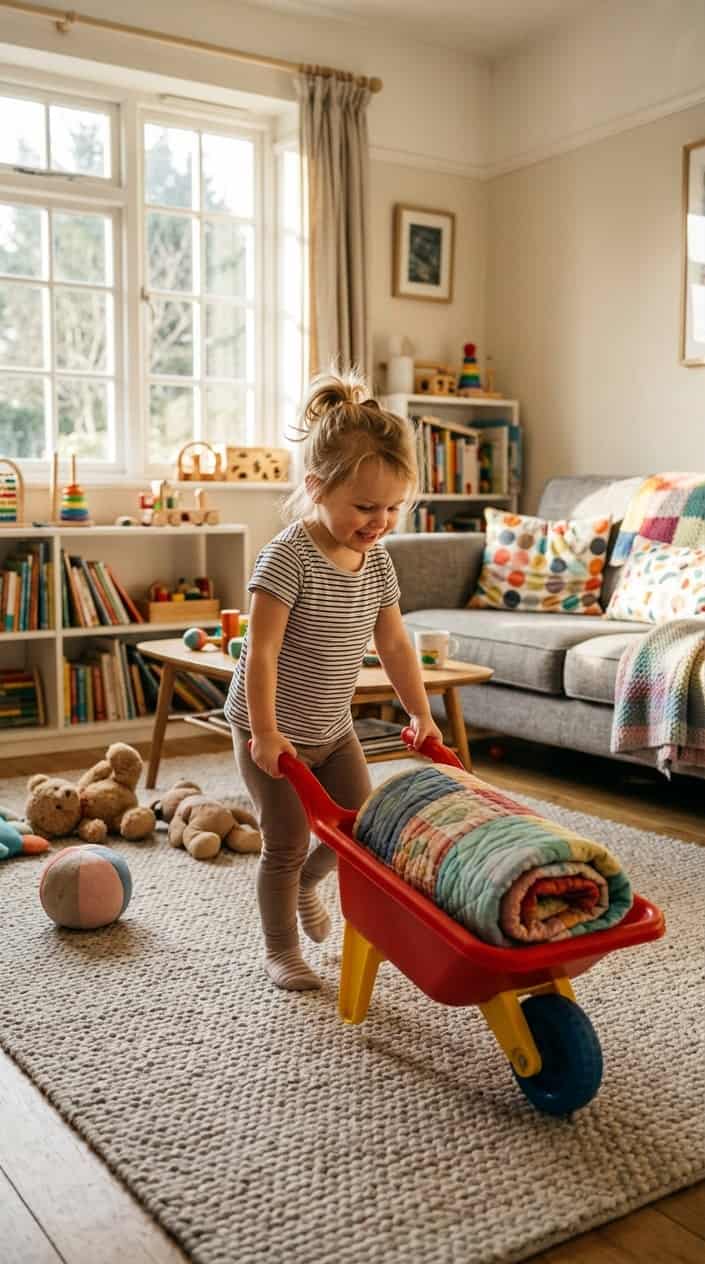
I take a blanket and roll it up into a tube shape, then lift the ends. This creates a sort of tunnel for the child to walk on their hands while I hold their legs (like a wheelbarrow). There is usually lots of giggling and a not-so-serious race to the couch.
The activity involves large muscle groups, including the shoulders, arms, and core. Balance and teamwork are also involved. It’s gross motor skills in action without sounding like gym class.
When getting ready to start the activity, be sure to have a soft blanket and a safe space. If the hard floor is where you’ll be doing this, a rolled-up blanket to be used as padding is ideal in order to protect their hands. For older kids, I hold lower on the legs; for younger ones, I support at the hips so they feel steady.
11) Dance Party Freeze Game

I stream fun music, and we dance, twirl, and wiggle in our couch-free zone until I say freeze, and they all strike a funny pose. It might seem crazy and silly, and sometimes the dog joins in too.
From a gross motor viewpoint, there is plenty of running, sudden stopping, short pauses on balancing, and quick feet, along with the control of the core and rotation of the shoulders. It’s large movements in short, quick bursts.
All you need is an empty area and some music to get the kids moving! With toddlers, I suggest some slower music and simple poses. As for the bigger kids, I add extra challenges like one-legged holds or slow-motion freezes.
12) Hopscotch Grid with Painter’s Tape

Don't lose this article. Enter your email below, and I'll send it to you right now. Plus a little encouragement and inspiration from me, straight to your inbox.
I use painter’s tape to make hopscotch patterns on the carpet, and all of a sudden, the whole family is involved – shoes are coming off, socks are sliding, and the dog is confused. It may seem silly, but it works with singles and doubles and a goofy “home” box at the end.
Without me having to yell upstairs, the children practice their skills in balancing, coordination, and jumping. It is gross motor in action with big leg pushes and soft landings controlled.
Simply find a soft surface and painter’s tape. For younger children, you can create wider spaces. For older children, create narrower spaces. If you want to add counting practice, you can even put numbers. When snack time comes, you can just peel the tape — no fuss, no mess.
13) Sensory Bin Treasure Dig (rice or beans)

I set a shallow bin on the coffee table, pour in rice, and toss in some random toys, and the kids become full-blown archaeologists while I sip coffee. They are excavating, messy but oddly peaceful, sitting, squatting, and leaning over.
This involves gross motor skills because they need to use arm strength, control of the shoulders, and balance as they lean and shift their weight to get the treasure. It also requires a combination of both fine and gross motor skills when they use cups or tongs to scoop.
Set up this activity easily by grabbing a baking tray or a shallow box and filling it with dry rice or beans. Mix in some plastic animals, coins, or pom-poms. If you want to increase the difficulty, add measuring cups, spoons, and tongs (which will also increase the complexity). For older children, you can create a timer challenge. For toddlers, watch closely and remove any larger items.
14) Mini Trampoline Jump Sets

I brought a small trampoline into the living room, and we take turns jumping on it for around 20-30 seconds. After that, we do a super quick break so we can get some breath and laugh at the cat. This kind of feels like cardio because we don’t have to leave the house.
This is a gross motor activity since it assists with balance, timing, and control of the core. The legs and lungs are also activated. This activity is low impact, but can still be tiring. It also allows people to do large movements without too much chaos.
To ensure safety, make sure there’s space on all sides of the trampoline. If you are worried about balancing, you can get a smaller trampoline that has a handle. For adaptations, toddlers can hold your hand, jump challenges can be done by older kids, adults should wear supportive shoes if you plan on staying on the trampoline for a long time, and jump challenges can be done by older kids.
15) Push-Pull Toy Train Lines

When I took out the wooden train tracks, the kids turned into little conductors, pulling trains as if they were on a special mission. They would go in a circle around the coffee table, and sometimes they would do a zigzag to go over a pillow bridge.
This activity is great for building arms and shoulders, as well as developing balance due to the pushing, pulling, kneeling, and reaching involved. It is an energetic activity and is fun.
You will need some wooden or plastic train sets and an open space on the floor. For toddlers, create simple loops, and for older children, build longer and more complex tracks with twists and turns. You can also use couch cushions as climbing tunnels.
16) Yoga Flow for Busy Toddlers

This one is sort of silly, but it does the trick. I take out a mat, and we do a five-minute flow in the living room. I do all the motions with loud meows, and I try to get my kids to do cat-cow with me. Someone leans on me during tree pose, and we finish with a big crash into a blanket pile. I do this for my own sanity while also getting us all to move a little.
This activity is great gross motor work because they are practicing balancing, holding their core tight, and shifting their weight from foot to foot. It’s low impact, but still great for coordination.
Choose any three easy poses, set a timer for two minutes, and grab a yoga mat or towel. For younger kids, do the poses together. For older toddlers, do wobble stands or reach for a stuffed animal for an added challenge!
17) Grocery Bag Parachute Play

I toss a big reusable grocery bag into the air, and the kids rush underneath as I do a mini parachute coach drop. It looks kind of silly with three kids under the bag giggling while I try not to break it, but they love the whoosh.
As the bag billows, they must squat, stand, reach, and hold their balance. Gross motor skills are in use. To pop up, they use core muscles, and coordination is needed to time the lift.
Grab a couple of sturdy reusable grocery bags and clear out some space on the floor. If you’re doing this with toddlers, you’re going to want to sit down and lift up slowly, but if you’re doing this with older kids, you can lift them up faster and even add a soft ball to the mix to bounce inside the bag.
18) Timed Toy Pickup Races

I yell “30 seconds!” and kids go into clean-up ninja mode, catapulting stuffed animals into baskets as I time them on my phone. It looks really chaotic, but somehow it gets the toys off the floor while leaving a proud, out-of-breath mess.
Evacuation games aid with full body coordination and core strength because you are doing gross motor activities like running, twisting, and reaching, but you do not feel like it is exercise.
Tip: Use kitchen timers or phones as clear time zone indicators for toys and basket zones. You can extend the time and widen the target zones for toddlers. For big kids, difficulty can be increased by adding obstacles or a funny movement before each throw.
19) Cushion Leapfrog Course

I set out pillows and couch cushions in the living room while I prepare my tea. It keeps the kids busy while they pretend to be frogs and jump over obstacles. It gets a little loud and messier than usual, but I love the distraction while I take a break.
As children practice jumping, landing, and adjusting on soft and uneven surfaces, they simultaneously develop their leg strength. Additionally, they begin to learn how to time their movements as well as develop spatial awareness as they make decisions on where to jump next.
You just need pillows, cushions, a small blanket for a “mud” pit, and some space on the floor. Placing cushions 1 or 2 steps apart is good for toddlers. Preschoolers can jump more than that. If you want to make the activity slower, use beach towels instead of cushions. You could even add a timer. Band-aids not included. I keep a stash of them for after the races.
How to Make Your Living Room Movement-Friendly Without Losing Your Sanity

I remove breakable items, and my children understand not to go all out and put a bunch of toys out. If you pick the right storage, you can use a quick-change storage to make the room safe, easy to alter, and attractive.
Kid-Proofing for Less Drama
I put breakables away and put sticky rubber pads under lamps and vases so they don’t slide when someone lunges for a ball. Also, I always end up wall framing my TV and moving the coffee table to the side for this.
I keep a foam folding mat or a thick blanket for falls. Covering the landing is important. I take out my decorative pillows and replace them with thicker ones to let the kids use some as stepping stones or balance props. To avoid trip hazards, I zip tie my loose cords against the wall and put the chargers in a drawer.
Moving past the bookshelf and staying with you for obstacle courses keeps the fighting down and saves me the trouble of chasing little kids around the carpet.
Storage Solutions When You’re Over Wicker Baskets
On the bottom shelves, I switched out my wicker baskets for labeled bins. Instead of baskets, toy storage is now more convenient with easily accessible, lidded bins and fabric cube containers. Each bin has a photo or a word to help the kids so they know where to put stuff.
I have a rolling cart for my art supplies and another for sports equipment. I roll them into my closet when I need space. For everyday use, it’s a bench with storage built in. The kids can sit, stash, and you aren’t tripping over foam blocks.
For activity setup, I use a “today” tote, which has cones, soft balls, and ropes. After playing, I slide the tote under the couch or bench. This way, swapping is easier instead of asking people to help with the cleanup.
Keeping Sibling Squabbles (and Your Couch) in Check

I picture a giant castle made of pillows, with me as the referee with a broom. I will set the boundaries, assign the roles, and before it gets too loud, I will replace roughhousing with fun competitions to keep everyone happy.
Setting Ground Rules Everyone Might Actually Follow
Some rules include no hitting, no shoes on the carpet, and speaking quietly when “pause” is called. I also place a rule note on the TV for the kids so they don’t have to keep asking me.
I hand out every role (scorekeeper, timer, or cushion guard) to each kid. It creates a sense of responsibility for each child and will decrease snitching. Kids who break the rules get a five-minute switch of roles. This is an actual consequence and one that kids seem to care about.
Make signal stops visible: use something like a red sock on the armchair as a soft-stop signal. When it shows up, everyone freezes. It’s silly, quick, and stops rolling wrestling before the couch cushions fly.
What Works When They Start Wrestling Instead of Playing
In wrestling, I don’t yell. Instead, I say freeze and take the red sock. If they keep going, I take the best prop, usually the pillow fort roof, and do a timed break, which I assume is worse than getting a badge for no participation.
You can have them change to another activity that still has the same energy, like a ground obstacle course or a balance challenge. I have started using 5-minute timers and offering a choice of music as rewards to shift the focus from fighting to teamwork and competition in a friendly way.
If I have a child who is constantly being aggressive, I will do parallel play. Each child gets the same tasks to do side by side so that they don’t feel like they are being punished, and can work on their self-calming skills.